Walk into any high-end architectural project anywhere in the world — a five-star hotel lobby in Dubai, a residential villa in California, a commercial tower in London — and you will almost certainly find granite or marble at its heart. Both stones have graced human spaces for millennia. Both are quarried from the earth, shaped by geological forces over millions of years, and prized for their natural beauty.
But they are fundamentally different materials, with different strengths, different weaknesses, and different ideal applications. Choosing the wrong one for your project is a costly mistake — one we see clients make time and again when they buy on aesthetics alone.
At Stone Harbor, we source and export both granite and marble directly from quarries across Rajasthan and other prime stone-producing regions of India. We have worked with architects, interior designers, property developers, and contractors across the United States, United Kingdom, Dubai, Australia, and China. This guide is built on that experience — real, firsthand knowledge of how each stone performs across climates, applications, and project scales.
Understanding What You Are Working With
What Is Granite?
Granite is an igneous rock — formed when molten magma deep within the earth’s crust cools and solidifies over millions of years. The slow cooling process creates an interlocking crystalline structure composed primarily of quartz, feldspar, and mica. This geological origin is why granite is so exceptionally hard and dense.
On the Mohs hardness scale, granite rates between 6 and 7 out of 10 — making it one of the hardest natural stones used in construction and design. Its low porosity (typically below 0.5% water absorption for high-quality export-grade material) means it resists staining, moisture penetration, and bacterial growth far more effectively than most competing surfaces.
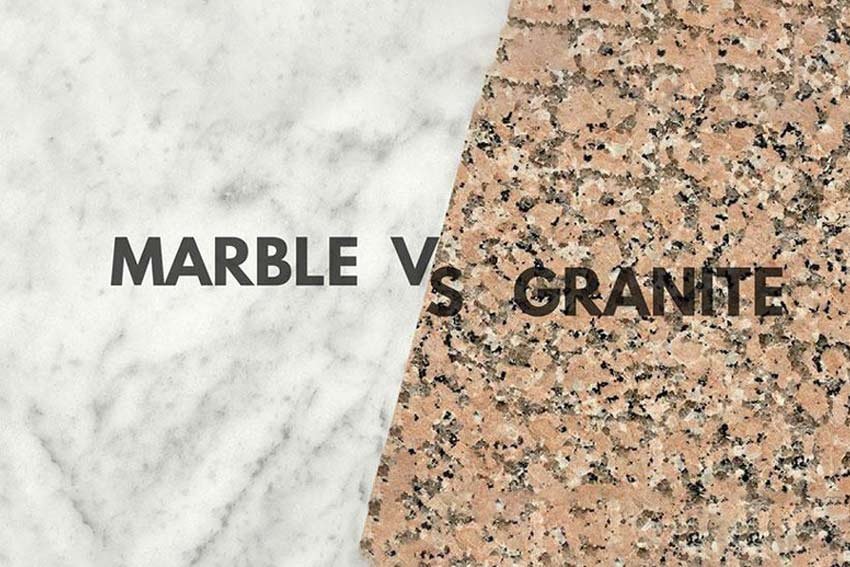
Visually, granite is characterised by its speckled, granular appearance — flecks and crystals distributed across the stone’s surface. Colours range from classic blacks and greys to warm creams, rich reds, deep blues, and dramatic golds. No two slabs are identical, but the variation tends to be distributed uniformly rather than in veining patterns.
What Is Marble?
Marble is a metamorphic rock — created when limestone or dolomite is subjected to intense heat and pressure deep within the earth, causing a process called recrystallisation. This transformation produces marble’s most distinctive characteristic: its flowing, veined patterns, which arise from mineral impurities like clay, silt, and iron oxides present in the original limestone.
Marble ranks between 3 and 5 on the Mohs hardness scale — considerably softer than granite. Its porosity is also higher, ranging from 0.5% to over 2.0% depending on the variety. This combination of relative softness and higher porosity shapes nearly every practical consideration when working with marble.
What marble offers in return is a visual quality that granite simply cannot replicate: a depth of translucence, a warmth of tone, and a veining complexity that has made it the defining material of classical architecture, from the Parthenon to the Taj Mahal.
How They Actually Perform: The Practical Differences
Durability and Scratch Resistance
This is where the geological origins become immediately practical. Granite’s hardness means it resists scratching from kitchen knives, keys, and most everyday objects without showing any surface damage. You can place hot pots directly on sealed granite without fear of scorching or cracking.
Marble’s softer surface is more susceptible to scratching from sharp objects and etching from acidic substances. Lemon juice, vinegar, wine, and even some cleaning products can react with the calcium carbonate in marble, leaving dull marks called etches on the polished surface. These are not stains that can be wiped away — they are chemical reactions that alter the stone’s surface.
This does not mean marble is a poor choice. It means it requires specific environments and users who understand its nature.
Porosity and Stain Resistance
High-quality granite typically absorbs less than 0.5% water — a near-impermeable surface when properly sealed. A spill of red wine, cooking oil, or coffee on sealed granite gives you time to wipe it away without permanent staining.
Marble’s absorption rate of 0.5% to over 2.0% makes it meaningfully more porous. Unsealed or inadequately sealed marble can absorb liquids within minutes, leading to deep, permanent staining. This is particularly relevant in kitchens, outdoor installations, or any high-use environment where spills are routine.
Maintenance Requirements
Granite is among the lower-maintenance natural stones available. A quality sealant applied once per year — or even less frequently for denser varieties — is typically sufficient. Daily cleaning requires nothing more than mild soap and water.
Marble requires sealing every six months to maintain optimal protection, and sometimes more frequently for light-coloured marble in high-traffic areas. Only pH-neutral, stone-specific cleaners should be used — common household cleaners containing acids or strong alkalis can damage the surface. Marble in kitchen applications demands particular diligence.
Heat Resistance
Granite handles heat exceptionally well. Placing hot cookware directly on the surface is generally safe, though using trivets is always recommended as a precaution to maintain the sealant and surface integrity over time.
Marble is heat-sensitive relative to granite. Prolonged or direct heat contact can cause cracking or discolouration, particularly in lighter varieties. Trivets and heat protection are essential for marble in kitchen environments.
Aesthetic Differences: More Than Just Looks
Both stones are beautiful. But they communicate different things in a space, and choosing between them is as much a design decision as a practical one.
Granite’s speckled, mineral-rich appearance reads as grounded and bold. It suits contemporary, industrial, and transitional design styles well. Its colour range is extraordinary — from the deep black of Absolute Black Granite quarried in South India to the warm gold of Alaska Gold, the dramatic blue of Vizag Blue, and the luxurious red of Imperial Red. This variety makes granite adaptable across design vocabularies.
Marble’s flowing veins create movement, drama, and an unmistakable association with luxury and classical elegance. No two marble slabs look alike — the veining is entirely unique, making large-scale marble installations inherently one-of-a-kind. This uniqueness is part of marble’s enduring appeal in luxury residential and hospitality design.
Which Stone Is Right for Your Project?
Choose Granite When:
- Kitchen countertops are involved — granite’s combination of scratch resistance, heat tolerance, and stain resistance makes it the superior functional choice for active kitchens.
- High-traffic flooring is required — commercial lobbies, public spaces, and busy residential areas benefit from granite’s durability under heavy footfall.
- Outdoor applications are planned — granite’s low porosity makes it highly resistant to freeze-thaw cycles, UV exposure, and moisture, making it far better suited to exterior facades, cladding, paving, and outdoor kitchens than marble.
- Low maintenance is a priority — for developers, commercial operators, or owners who prefer a stone that demands less ongoing care.
- Budget efficiency matters — granite generally offers more durability per pound spent than marble, particularly for large-scale projects.
Choose Marble When:
- Luxury bathroom surfaces are the goal — marble vanities, shower walls, and bath surrounds create a spa-like atmosphere that granite cannot replicate. The lower moisture and acid exposure in bathrooms also suits marble’s properties.
- Feature walls and fireplace surrounds — areas of visual focus that are not subject to heavy daily use are ideal for marble’s beauty.
- Decorative and sculptural applications — marble’s relative workability makes it easier to cut, carve, and shape for intricate detailing.
- Hotel lobbies and reception areas — high-end hospitality environments where trained maintenance staff will care for the stone daily.
- The aesthetic is non-negotiable — if the specific veining and warmth of marble is the design vision, and the appropriate maintenance commitment can be made, marble is irreplaceable.
A Note on India’s Natural Stone Advantage
India is one of the world’s largest exporters of both granite and marble, accounting for a significant share of global natural stone exports. Rajasthan alone is home to an extraordinary concentration of quarries producing some of the world’s finest granite varieties — Absolute Black, Steel Grey, Tiger Skin, River Blue, and many more — alongside premium marbles including Rainforest Green, Fantasy Brown, and Banswara White.
Working directly with an Indian exporter like Stone Harbor means access to stone sourced close to the quarry — with full visibility into quality, grade consistency, and processing standards. It eliminates multiple layers of middlemen, which in turn improves both quality control and cost efficiency for international buyers.
The Bottom Line
Granite and marble are not competing products — they are different tools for different jobs. Granite is the pragmatist’s stone: extraordinarily durable, low-maintenance, and adaptable across environments. Marble is the aesthete’s stone: irreplaceably beautiful, deeply historical, and reward-rich for those willing to care for it properly.
The right choice depends on where the stone will live, how it will be used, who will maintain it, and what story you want it to tell. If you are working on a project and are unsure which direction to take, we are happy to advise based on the application, climate, and design brief. That is exactly the kind of conversation we have been having with our clients around the world for years.
Explore our full range of granite and marble at stoneharborexports.com, or contact us to discuss your project requirements.