As our global population continues to gravitate toward metropolitan centers, the blueprint for the "city of the future" is being rewritten. We are no longer just building for density; we are building for resilience, efficiency, and environmental harmony. At the heart of this shift is the Leadership in Energy and Environmental Design (LEED) certification: the most widely used green building rating system in the world.
For architects, urban planners, and developers, achieving LEED certification isn't just about high-tech HVAC systems or solar panels. It starts from the ground up, literally. The choice of paving material for public plazas, airport terminals, and pedestrian walkways plays a massive role in a project's sustainability score. This is where high-quality grey granite slabs from India have emerged as a cornerstone of modern, eco-conscious urban design.
The Sustainable Logic: Durability equals Conservation
In the world of sustainable design, longevity is the ultimate form of conservation. When we talk about gray granite, we aren't just talking about a material that looks good for a decade. We are talking about a geological masterpiece with a 100+ year lifecycle.
Unlike synthetic alternatives: such as asphalt, poured concrete, or composite pavers: natural Granite does not require frequent replacement. Synthetic materials often degrade under UV exposure, heavy foot traffic, and temperature fluctuations, leading to a "rip-and-replace" cycle that carries a heavy carbon footprint. In contrast, a well-installed Steel Grey Granite walkway can serve several generations with minimal maintenance. By reducing the need for new raw materials and the energy-intensive manufacturing of replacements, natural stone significantly lowers the embodied carbon of a project over its total lifespan.

Technical Specifications: The Numbers Behind the Stone
When specifying materials for municipal or infrastructure projects, "feeling" sustainable isn't enough. LEED credits require hard data. Indian grey granite slabs are sought after by global engineering firms because their technical performance is, quite frankly, unmatched.
To withstand the rigors of an urban hub: think thousands of daily commuters at an airport or heavy maintenance vehicles on a plaza: the stone must possess extreme structural integrity.
- Compressive Strength: Premium Indian greys typically range between 2,000–2,500 kg/cm². This allows them to handle immense loads without cracking or deformation.
- Low Water Absorption: With a rate of less than 0.4%, these stones are virtually impervious to moisture. This is critical for freeze-thaw resistance in colder climates and prevents the deep staining that can plague more porous materials like Sandstone.
- Hardness: Scoring between 6 and 7 on the Mohs scale, these slabs are resistant to scratches and abrasions from grit and heavy footwear.
Whether you are looking for the uniform, deep tones of Steel Grey Granite or the subtle character of Adhunik Grey Granite, these technical specs ensure the investment holds its value for the long haul.
Combatting the Urban Heat Island Effect
One of the most significant challenges in modern urban planning is the "Heat Island Effect," where dark, non-reflective surfaces like asphalt absorb solar radiation and radiate it back, raising city temperatures.
LEED offers credits for "Heat Island Reduction" (Non-roof surfaces). To qualify, paving materials must have a high Solar Reflectance Index (SRI). While dark stones like Absolute Black Granite are iconic for interior accents, a lighter granite grey colour is often the preferred choice for expansive outdoor paving. Light to mid-toned grey granites reflect a significant portion of solar energy, helping to keep urban microclimates cooler and reducing the energy load required to cool surrounding buildings.
Safety First: Finishes for Public Spaces
Sustainability also encompasses human safety and accessibility. In a LEED-certified project, public spaces must be navigable and safe in all weather conditions. This is where the versatility of granite finishing becomes a design asset.
For interior applications like lobbies, a polished or honed finish might be ideal. However, for exterior urban paving, Stone Harbor Exports recommends flamed or bush-hammered finishes.
- Flamed Finish: Created by exposing the stone to high-temperature flames, which causes the surface crystals to burst, leaving a rugged, highly slip-resistant texture.
- Bush-Hammered Finish: A mechanical process that creates a uniformly pitted surface, offering exceptional grip even when wet.
These textures ensure that public plazas remain "slip-resistant" for pedestrians, fulfilling essential safety requirements without compromising the sophisticated aesthetic of the gray granite.

Sourcing and Ethics: From Indian Quarries to Global Sites
A critical component of LEED v4 and v4.1 is the "Materials & Resources" category, which emphasizes building product disclosure and optimization. Knowing exactly where your stone comes from is no longer a luxury: it’s a compliance necessity.
At Stone Harbor Exports, we take pride in our direct-from-source model. Our grey granite slabs are primarily sourced from the mineral-rich belts of Andhra Pradesh and Rajasthan.
- Andhra Pradesh (Karimnagar and Nizamabad): The home of the world-famous Steel Grey Granite. This region provides stones of exceptional consistency, which is vital for large-scale municipal projects where thousands of square meters must match perfectly in tone and texture.
- Rajasthan: Known for its diverse range of grey and white granites, including Adhunik Grey Granite. These quarries allow for a reliable, large-scale supply chain that can meet the rigorous timelines of international construction projects.
By working directly with quarries and managing the processing in our own facilities, we ensure that the stone is extracted and handled with the highest standards of quality control and logistical efficiency. This transparency is exactly what sustainability-focused developers need to document their supply chain for LEED credits.

The Aesthetic of Efficiency: Why Grey?
Beyond the technical and environmental benefits, there is a reason grey granite slabs remain the "Industry Insider" choice for urban design. Grey is the ultimate neutral. It bridges the gap between the organic and the industrial.
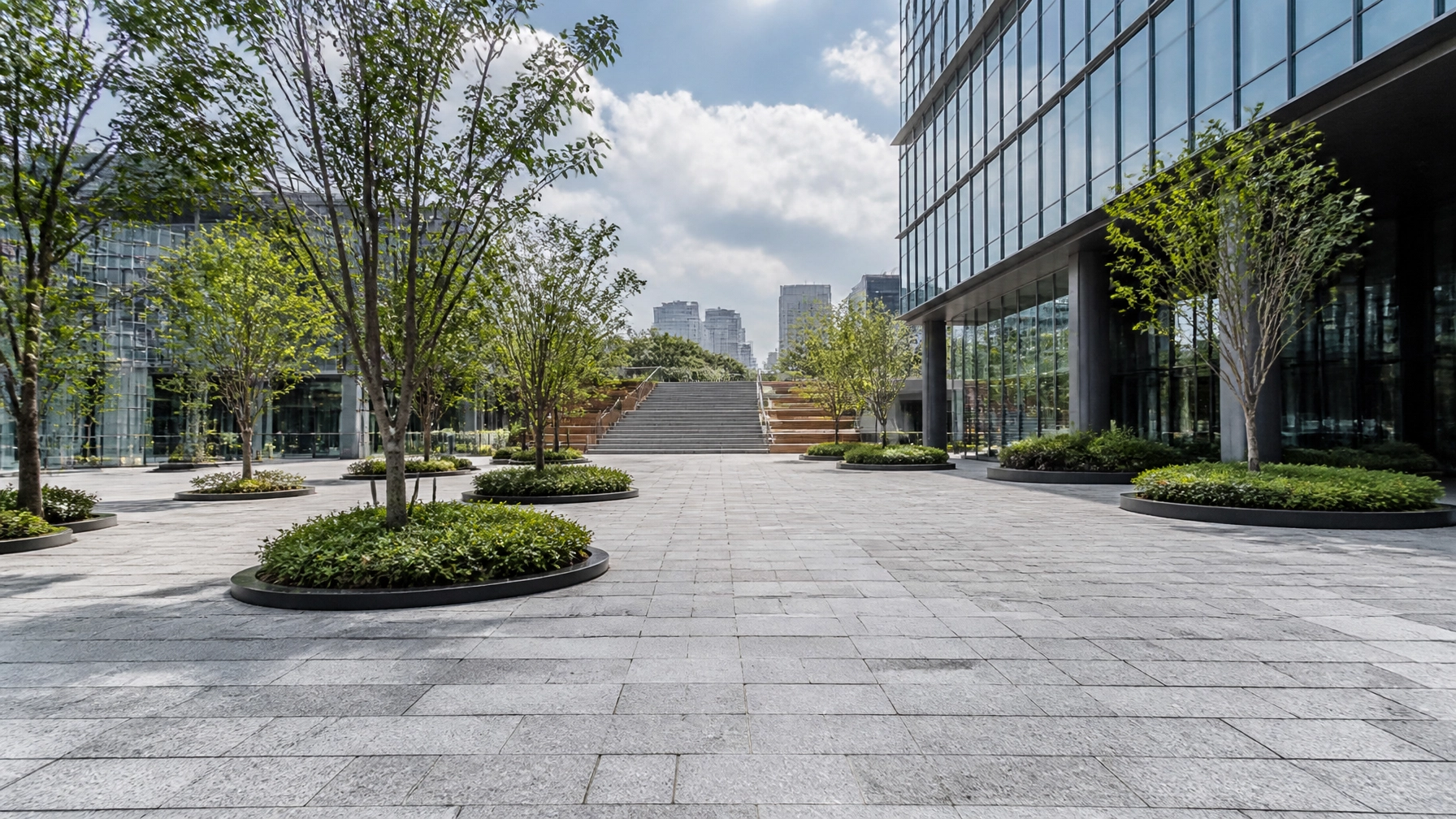
A Steel Grey Granite plaza complements the steel and glass of modern skyscrapers while providing a natural, grounding element that feels timeless. It doesn't distract; it enhances. Whether it’s paired with the bright, crisp look of New Kashmir White Granite or used as a subtle backdrop to lush urban landscaping, the granite grey colour provides a cohesive visual language for the modern city.
Conclusion: Building for the Next Century
The shift toward sustainable urban development is not a trend; it is a necessity. As we move toward more LEED-certified projects, the materials we choose must perform at a higher level than ever before.
Indian grey granite slabs offer the perfect intersection of ancient geological strength and modern sustainable requirements. By choosing a material with a century-long lifecycle, high solar reflectance, and incredible technical specs, you aren't just paving a walkway: you are investing in the permanent infrastructure of a greener planet.
At Stone Harbor Exports, we are committed to being your global export partner, delivering the finest Granite and Marble from Indian quarries to your project site, wherever in the world that may be. Let’s build cities that last.