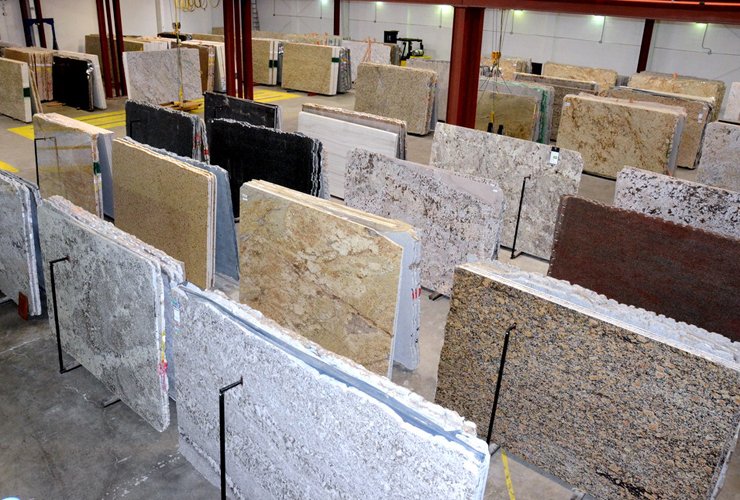
Choosing a granite slab should be straightforward. It is stone — one of the oldest building materials known to humanity. But spend any time in the industry, and you quickly learn that not all granite is created equal. The difference between a slab that looks stunning for decades and one that chips, stains, or fades within a few years often comes down to decisions made before the stone ever leaves the yard.
At Stone Harbor, we have been sourcing granite directly from quarries across India and exporting to clients in North America, Europe, the Middle East, Asia Pacific, and beyond. We work with architects, contractors, kitchen fabricators, and property developers who are buying stone at significant scale. Over the years, we have compiled the questions they ask, the mistakes we have seen, and the practical knowledge that separates a confident purchase from a costly one.
This guide covers what actually matters when selecting granite — beyond surface beauty.
1. Understand the Grading System Before You Start
Granite is commercially categorised into three broad grades, though it is important to note that this system is not standardised across the industry — different suppliers may use different terminology. Understanding the general framework helps you ask the right questions.
Level 1 (Commercial/Entry Grade): Typically thinner slabs (around 3/8 inch), often pre-fabricated, with limited colour variation. Cost-effective, but lower durability and less visual distinction. Requires plywood backing for structural support.
Level 2 (Standard/Mid Grade): Generally around 3/4 inch thick, featuring more colour variation and pattern. Commonly sourced from India or Brazil. Better durability and a more considered appearance than entry-level material.
Level 3+ (Premium/High Grade): Thicker slabs (3/4 inch or more), featuring rare colours, distinctive patterns, and exceptional finish quality. Sourced from premium quarries with consistent block quality. The best long-term investment for countertops, feature surfaces, and high-specification projects.
When working with a supplier, always ask explicitly which grade you are purchasing and request the quarry of origin. Reputable exporters will answer both questions clearly and without hesitation.
2. Inspect the Slab in Person Where Possible — or Request Photographs and Videos
Granite is a natural material. Every slab is unique, and photographs on a website or in a catalogue — even high-resolution ones — cannot fully communicate the depth of colour, the movement in the pattern, or the quality of polish that you see when standing in front of a slab.
For locally purchased stone, inspecting slabs in person at the yard is always the best approach. View slabs both in natural light and under artificial lighting, since granite can appear significantly different between the two. Wet the surface slightly — a small amount of water on the surface reveals the stone’s true colour depth and simulates the appearance of a polished, sealed finish.
For international purchases, request high-resolution photographs of the actual slabs you will receive — not stock images — along with short videos showing the surface at different angles in both natural and artificial light. A supplier who is unable or unwilling to provide this should raise a concern.
3. Check Colour and Pattern Consistency Across the Lot
For large-scale installations — kitchen countertops, flooring, wall cladding — you will likely require multiple slabs. Ensuring those slabs are consistent in colour tone, pattern distribution, and background variation is critical to the final installation looking intentional rather than mismatched.
This is particularly important for lighter granites, where shade variation between slabs is more visible, and for projects requiring bookmatching — where slabs are oriented to create mirror-image patterns across seams.
At the quarry and processing level, reputable manufacturers group slabs by shade and grade. Ask your supplier whether slabs are sorted by batch or lot, and confirm that all slabs in your order come from the same or closely matched quarry blocks. This is standard practice in professional export operations, but it is worth confirming explicitly.
4. Assess Polish Quality — the Finish Tells You a Great Deal
The polish on a granite slab is one of the most immediate indicators of its overall processing quality. A well-polished granite surface reflects light evenly, shows no dull patches or inconsistencies, and feels uniformly smooth to the touch across the entire slab.
According to Indian Bureau of Standards specification IS 14223-1:1995, polished granite should achieve a mirror finish with a gloss level of not less than 95% when measured with a glossmeter. This is the standard applied to export-grade Indian granite.
A practical field test: stand to one side of the slab and look across the surface at an oblique angle in good lighting. Inconsistencies in the polish — dull spots, areas of lower reflectivity, or visible surface texture variation — will be immediately apparent from this angle when they might not be visible face-on.
Machine-polished granite generally produces a more consistent finish than hand-polished material. Ask your supplier how the stone was polished. For premium applications, machine-polished slabs are the standard.
5. Test for Porosity — This Determines Long-Term Performance
Porosity is one of the most important practical characteristics of any granite slab. Lower porosity means better stain resistance, less moisture penetration, and reduced susceptibility to bacterial harbourage. For export-grade high-quality granite, water absorption should be below 0.5% — this is the benchmark used in professional quality control testing.
A simple field test for porosity requires nothing more than water. Pour a small amount of water on the surface of the slab and observe what happens. On high-quality, dense granite, water should bead up and remain on the surface for several minutes before any absorption occurs. If the water is absorbed quickly — within 30 to 60 seconds — the stone has high porosity and will require more frequent sealing and more careful maintenance.
For granites destined for outdoor use or wet areas, request formal water absorption test results from your supplier. Third-party laboratory testing by recognised agencies such as SGS, TÜV SÜD, or Bureau Veritas provides independent verification that is worth requesting for significant purchases.
6. Verify Thickness and Dimensional Accuracy
Slab thickness directly affects structural integrity, durability, and installation requirements. For countertop applications, the industry standard is approximately 3 cm (roughly 1.2 inches) for primary surfaces. Thinner slabs — below 2 cm — may be acceptable for some applications but require additional support and are more prone to cracking under stress, particularly at cut-outs for sinks and cooktops.
Thickness should be uniform across the slab. Measure at multiple points along the edges. A tolerance of ±1 mm is standard for export-quality material. Significant variation in thickness across a slab indicates inconsistent processing and will complicate installation.
For flooring tiles, dimensional accuracy (length and width to within ±2 mm, squareness within tolerance) is equally important, since installation depends on consistent sizing to maintain alignment across large areas.
7. Listen for Internal Integrity — the Sound Test
This test sounds simple because it is — and it is surprisingly reliable. Gently tap the surface of the granite slab with a metal object or your knuckle in several different spots. High-quality, dense granite produces a clear, resonant, ringing sound. A dull, flat, or thudding sound at any point suggests internal fractures, voids, or areas of reduced density.
This test is particularly useful when selecting granite in bulk or when evaluating slabs that may have been damaged during transport. It requires no equipment and takes seconds, but it can reveal structural weaknesses invisible to the naked eye.
8. Check for Artificial Treatment or Enhancement
Some lower-quality granite — particularly darker varieties — is artificially treated with dyes, resins, or coatings to achieve a richer, more uniform appearance. While treated granite may look attractive initially, these treatments tend to degrade over time, resulting in uneven colouring, peeling, or a dull finish that is difficult to restore.
The acetone test is a practical method for detecting artificial colouring. Rub a small amount of acetone on the surface using a white cloth. If colour transfers to the cloth, the slab has been artificially treated. Genuine granite colouring is entirely mineral-based and will not transfer.
Reputable suppliers sourcing from established Indian quarries will confirm their stone is untreated and will provide documentation to that effect. If a supplier is evasive on this question, that itself is informative.
9. Understand the Finish Options and Choose for Your Application
The surface finish of a granite slab is not just an aesthetic choice — it affects durability, maintenance, and slip resistance depending on how the stone will be used.
- Polished: The mirror-finish standard for countertops and wall cladding. Maximises colour depth and reflectivity. Easier to clean but may show fingerprints and water marks in some lighting conditions. Slightly more slippery when wet.
- Honed: A matte finish with a smooth but non-reflective surface. More forgiving of scratches and fingerprints. A popular choice for flooring and bathroom surfaces. Slightly more porous than polished granite and may require more frequent sealing.
- Flamed: A rough, textured surface created by exposing the stone to extreme heat. Excellent slip resistance — the standard finish for outdoor paving, steps, and pool surrounds. Reveals the stone’s mineral structure in a dramatic way.
- Leathered/Brushed: A textured finish that preserves some of the stone’s natural grain while creating a soft, tactile surface. Increasingly popular in contemporary residential design for countertops and bathroom vanities.
- Bush-hammered: A heavily textured, coarse finish achieved by mechanical treatment. Used primarily for outdoor applications and architectural facades where maximum texture and slip resistance are required.
10. Work with a Supplier Who Provides Traceability
For significant purchases — whether you are a homeowner investing in kitchen countertops or a developer procuring stone for a large commercial project — the supplier relationship is as important as the stone itself. A reliable supplier should be able to tell you exactly where the granite was quarried, how it was processed, what quality checks it underwent, and what certifications apply.
For export orders, ask about packaging and shipping standards. Granite slabs require proper wooden crating, foam protection, and secure loading to arrive without damage. An experienced exporter will have established logistics protocols and will provide documentation including packing lists, certificates of origin, and quality inspection reports.
Third-party inspection — conducted by agencies such as SGS, TÜV SÜD, or Bureau Veritas — provides independent quality verification before shipment. This is standard practice for significant export orders and is worth requesting.
A Final Word on Investing in Quality
Granite is a long-term investment. A quality slab, properly installed and maintained, will outlast the building it is installed in. The decisions made at the selection stage — grade, thickness, finish, supplier reliability — determine the return on that investment.
The most common regret we hear from buyers is not that they spent too much on granite. It is that they prioritised price over quality and ended up with stone that did not perform as expected, or a supplier relationship that did not provide the support they needed when problems arose.
Buy from quarry to destination with full transparency, verify quality with the tests outlined above, and choose a supplier who stands behind their material. That combination — verified quality from a trusted source — is what makes natural stone the enduring material of choice for the world’s finest spaces.
Browse Stone Harbor’s full granite collection at stoneharborexports.com/product-category/granite/ or contact us to discuss your project specifications and sourcing requirements.